
From Gate to Ball: Understanding Different Types of Valves for Home and Commercial Use
- SURESH K
- Nov 11, 2025
- 5 min read


Valves may seem like small, simple parts in your plumbing or mechanical system, but they play a critical role in controlling water, gas, and other fluid flows. Whether it’s a small tap in your home kitchen or a complex network in a commercial plant, choosing the right valve can mean the difference between smooth operation and costly system failure.
In this blog, we’ll explore the different types of valves commonly used in both residential and commercial settings—their design, purpose, advantages, and where they best fit.
1. What Is a Valve?

A valve is a mechanical device that controls, regulates, or directs the flow of a fluid—usually water, gas, or air—by opening, closing, or partially obstructing passageways.
Every plumbing or mechanical system depends on valves to:
Start or stop fluid flow
Prevent backflow
Regulate pressure
Protect equipment and users
Valves can be manual, where a person turns a handle or lever, or automatic, controlled by sensors or actuators.
2. Common Types of Valves and Their Functions
Let’s break down the most widely used valve types you might encounter—from the simple gate valve in your home to the high-precision control valve in industrial systems.
a) Gate Valve

Function: To start or stop water flow (not for flow regulation).
Gate valves use a metal gate or wedge that moves up and down inside the valve body. When fully open, the gate lifts to allow unobstructed flow; when closed, it seals tightly.
Where used:
Main water supply lines
Irrigation systems
Industrial pipelines
Advantages:
Minimal flow restriction when open
Simple design and long lifespan
Limitations:
Not suitable for throttling (can cause damage if partially open)
Slower to operate compared to ball valves
b) Ball Valve

Function: Quick on/off control.
This type uses a rotating ball with a hole through its center. When aligned with the pipe, flow passes freely; when rotated 90°, flow stops instantly.
Where used:
Home water lines
Industrial and chemical systems
HVAC and compressed-air systems
Advantages:
Quick quarter-turn operation
Tight sealing, even after years of use
Durable and low maintenance
Limitations:
Not ideal for throttling applications (risk of seat damage)
Ball valves are the most popular for residential and light commercial use because they are reliable, affordable, and easy to operate.
c) Globe Valve

Function: Flow regulation and throttling.
A globe valve features a movable disk and stationary ring seat. The disk moves perpendicularly to the seat, allowing precise flow control.
Where used:
Cooling water systems
Boiler and feedwater lines
Chemical processing plants
Advantages:
Excellent for flow control
Tight shut-off capability
Limitations:
Higher pressure drop compared to gate or ball valves
More complex structure and costlier maintenance
d) Check Valve

Function: Prevents backflow in a piping system.
A check valve allows fluid to flow in one direction only. When flow reverses, the valve automatically closes, preventing contamination or system damage.
Where used:
Pump discharge lines
Water heaters and booster systems
Sewage and wastewater systems
Advantages:
Fully automatic—no manual operation needed
Protects pumps and equipment from reverse flow
Limitations:
Requires correct installation orientation
May cause water hammer if not properly selected
e) Butterfly Valve

Function: Flow isolation and throttling.
Butterfly valves use a flat circular disc that rotates inside the pipe. When the handle turns, the disc rotates on a shaft to open or close the flow.
Where used:
Large-diameter pipelines
Fire protection, HVAC, and chemical systems
Advantages:
Compact and lightweight
Easy to install and operate
Cost-effective for large pipes
Limitations:
Less tight shut-off compared to ball valves
Not ideal for high-pressure systems
f) Pressure-Reducing Valve (PRV)

Function: Regulates and maintains safe downstream pressure.
PRVs automatically reduce high inlet pressure to a safe, consistent outlet pressure.
Where used:
Domestic water supply systems
High-rise building plumbing
Industrial process lines
Advantages:
Prevents pipe damage and leaks due to high pressure
Ensures stable water flow and saves water
Limitations:
Requires occasional maintenance to prevent clogging or wear
g) Solenoid Valve

Function: Electrically controlled valve for automatic systems.
Solenoid valves use an electromagnetic coil to open or close the valve when energized.
Where used:
Irrigation systems
HVAC and air-conditioning units
Fire-fighting systems and automation panels
Advantages:
Precise remote control
Fast response time
Easily integrated with sensors or PLCs
Limitations:
Requires electricity to function
Coil failure can cause malfunction if not maintained
3. How to Choose the Right Valve

Selecting the right valve depends on several key factors:
Criteria | Considerations |
Purpose | Is it for on/off control, regulation, or safety? |
Medium | Water, gas, air, oil, or chemicals? |
Pressure & Temperature | High-pressure systems need stronger materials like stainless steel. |
Size & Space | Compact options like ball or butterfly valves suit tight spaces. |
Operation | Manual, electric, or pneumatic? |
Budget | Brass and PVC are economical; stainless steel offers longevity. |
For example, in home plumbing, a ball valve is ideal for quick shut-off, while in commercial buildings, a butterfly valve handles larger diameters efficiently.
4. Material Matters: Brass, PVC, or Stainless Steel?

Choosing the right material ensures durability and safety:
Brass valves: Common in domestic water systems. Resistant to corrosion, cost-effective, and long-lasting.
PVC (Plastic) valves: Lightweight and ideal for low-pressure or chemical applications.
Stainless steel valves (SS304 or SS316): Used in food, pharmaceutical, and industrial systems for corrosion resistance and strength.
Cast iron valves: Suitable for large-scale, heavy-duty applications.
5. Maintenance Tips for Longer Valve Life

Even the best valve can fail if neglected. Here’s how to keep them working efficiently:
✅ Operate periodically: Move manual valves occasionally to prevent seizing.✅ Check for leaks: Small drips can indicate seal wear or seat damage.✅ Lubricate moving parts: Especially in older gate or globe valves.✅ Replace worn seals or washers: Don’t wait for leaks to worsen.✅ Inspect for corrosion: Especially in outdoor or high-humidity installations.
A well-maintained valve can last 10–20 years or more depending on use and environment.
6. Real-World Example: Domestic vs. Commercial Application

Home Use:
Ball valves for kitchen and bathroom shut-offs
PRVs for incoming main water supply
Check valves for water heaters and pumps
Commercial Use:
Gate or butterfly valves for mainline isolation
Globe valves for flow control in mechanical systems
Solenoid valves for automation and control systems
By matching valve type to application, both homes and commercial facilities achieve better safety, water efficiency, and performance reliability.
7. Final Thoughts
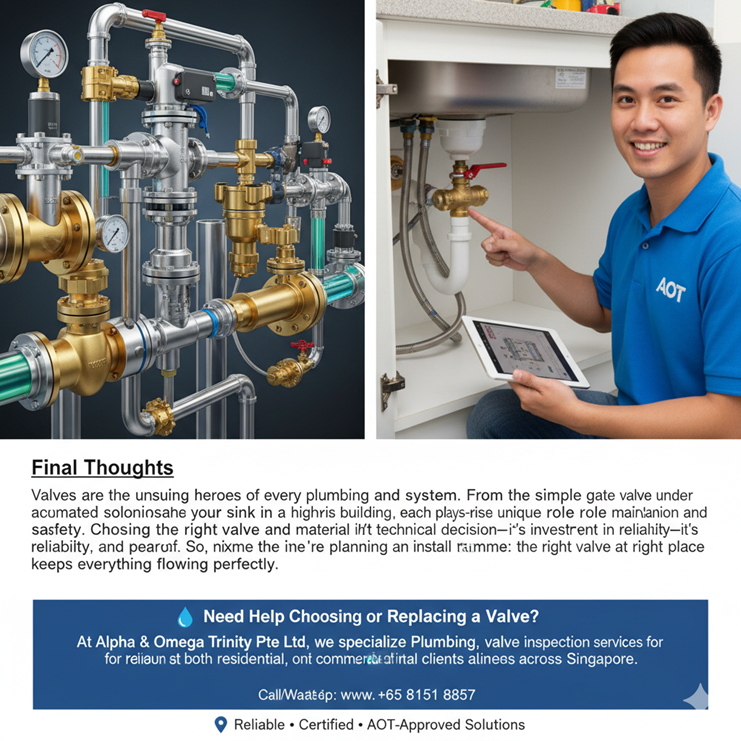
Valves are the unsung heroes of every plumbing and mechanical system. From the simple gate valve under your sink to the automated solenoid valves in a high-rise building, each plays a unique role in maintaining smooth operation and safety.
Choosing the right valve type and material isn’t just a technical decision—it’s an investment in reliability, efficiency, and peace of mind.
So, next time you’re planning an installation or maintenance project, remember: the right valve at the right place keeps everything flowing perfectly.
Need Help Choosing or Replacing a Valve?
At Alpha & Omega Trinity Pte Ltd, we specialize in plumbing, valve inspection, and replacement services for both residential and commercial clients across Singapore.
💧 Call/WhatsApp: +65 8151 8857🌐 Website: www.aotrinitysg.com📍 Reliable • Certified • AOT-Approved Solutions


Comments