
🛠️ The Real Reason Your Booster Pump Keeps Failing — And How to Fix It Right
- SURESH K
- Dec 15, 2025
- 5 min read


Booster pumps are the hidden heroes behind strong, steady water pressure in Singapore’s homes, condos, commercial buildings and industrial systems. Whether it is a high-rise condominium rooftop pump room or a landed property booster system, these pumps work silently in the background to ensure that every tap, shower, and system gets sufficient pressure on demand.
But once the booster pump begins to fail, you will immediately feel it — low water pressure, noisy operation, vibration, overheating, inconsistent flow, or sometimes even complete system failure. While many people assume “the pump is old” or “maybe the motor is faulty,” the truth is often more complex.
In this blog, we uncover the real reasons booster pumps fail, the hidden issues your system might be suffering from, and most importantly, how to fix the problem the right way — so it doesn’t return.
1. Booster Pumps Rarely Fail Suddenly — There Are Always Warning Signs

Most booster pump failures happen gradually. Before the system collapses, there are always small signs:
Sudden drop in water pressure
Pump cycles too frequently
Loud humming or grinding
Vibrations at the base
Water hammer noise
Motor overheating
Booster pump tripping
Rusty or dirty water from pipes
Pressure tank acting unstable
Ignoring these early symptoms is what leads to heavy repair costs later. Booster pumps are mechanical devices — when one part starts weakening, other parts get stressed and follow shortly after.
2. The Real Reasons Booster Pumps Keep Failing
Below are the most common causes we see when attending pump rooms across Singapore condos, hotels, commercial sites and factories.
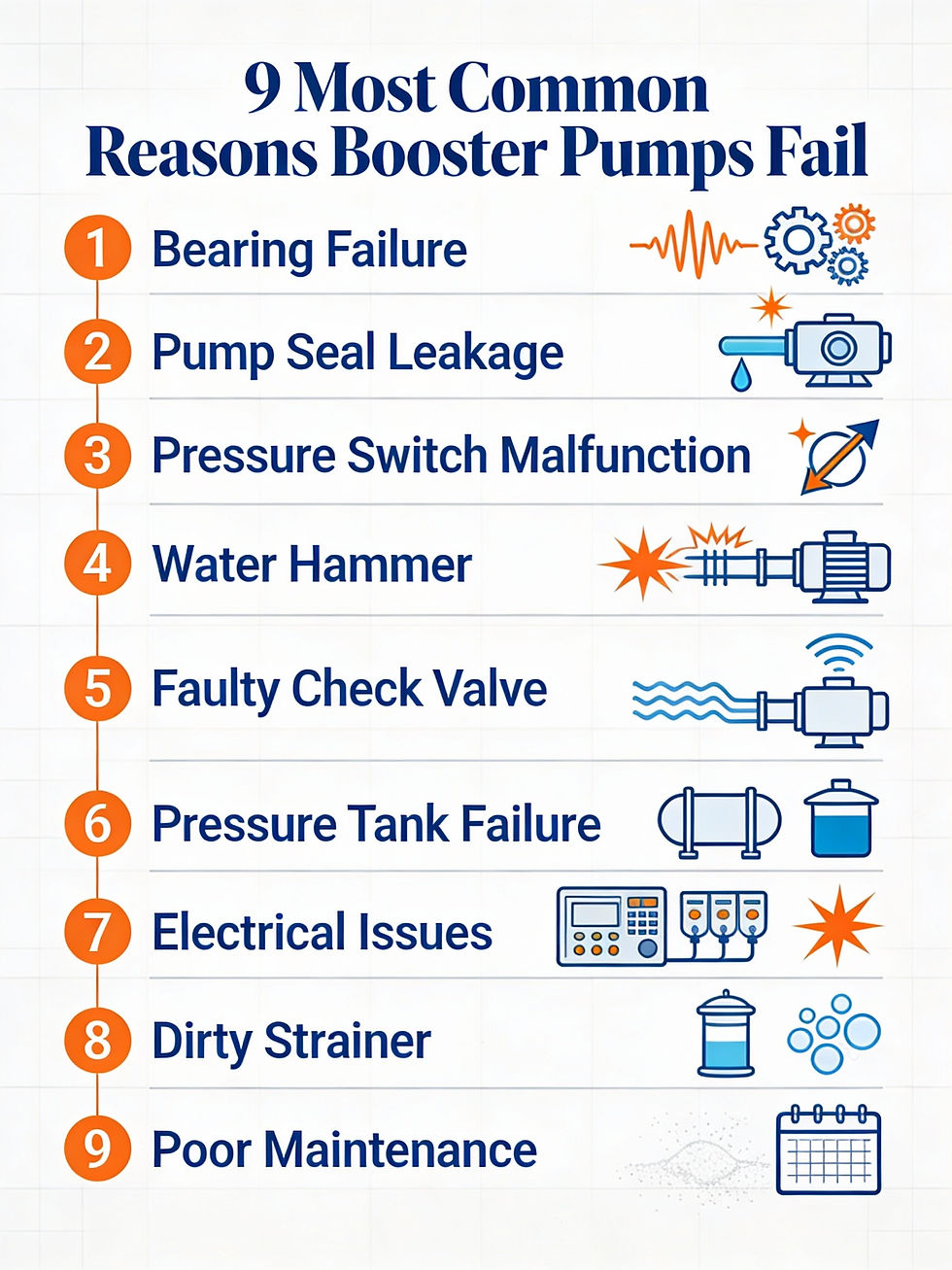
Reason 1: Bearing Failure — The Silent Killer
When the motor bearings wear out, you will hear loud noise, grinding, or vibration. This is one of the top reasons booster pumps fail.
Why bearings fail:
Age and normal wear
No lubrication
Misalignment
Overloading
Water penetration
Poor maintenance
A damaged bearing can cause:
Motor overheating
Shaft misalignment
Seal leakage
Complete motor burnout
If bearings are not replaced early, the repair cost jumps dramatically, sometimes requiring a full motor rewinding.
Reason 2: Pump Seal Leakage
A mechanical seal prevents water from entering the motor. When this fails, water seeps into the motor housing, causing:
Short circuit
Motor tripping
Severe rust
Internal corrosion
Pump failure
Seal failure often happens because of:
Dirty water
High pressure
Misaligned shaft
Excess vibration
Faulty installation
A leaking seal always needs immediate attention.
Reason 3: Pressure Switch or Sensor Malfunction
Booster systems rely on sensors to cut in and cut out. When these fail:
Pump runs non-stop
Pump keeps starting/stopping quickly (rapid cycling)
Water pressure becomes inconsistent
This damages the pump motor, pressure tank, and pipe network.
Reason 4: Water Hammer & Pipe Vibration
This is a hidden issue most clients never notice until we inspect. Water hammer is a “shockwave” created inside pipes that causes:
Pump vibration
Damage to impellers
Seal failure
Noise in the pump room
It happens when:
Check valves are faulty
Solenoid valves shut fast
Pressure tank malfunction
Poor pipe design
Over time, water hammer destroys the internal components.
Reason 5: Faulty Check Valve (Non-Return Valve)
A booster pump depends heavily on check valves to prevent water from flowing backwards.When the check valve fails:
Pump keeps running
Pressure drops
Water reverses direction
Motor overheats
Pump becomes noisy
This is one of the cheapest parts to replace but causes the biggest damage when ignored.
Reason 6: Pressure Tank Failure
A pressure tank balances the system. When the bladder fails or the tank loses pressure:
Pump starts too frequently
Pump overheats
Water pressure becomes unstable
A pressure tank issue will quickly damage:
Motor
Switches
Valves
Controllers
Regular servicing prevents this.
Reason 7: Electrical & Control Panel Issues
Booster pumps rely heavily on electrical controls, such as:
Contactors
Thermal overload relays
Relay points
MCB
RCD
Soft starter
VSD controllers
Failures in the control panel cause:
Motor tripping
Irregular pumping
Voltage imbalance
Overheating
Complete burnout
Electrical issues are often overlooked — until the pump stops completely.
Reason 8: Dirty Strainer or Clogged Inlet
If the Y-strainer or suction side is blocked, the pump starves for water. This causes:
Cavitation
High vibration
Noise
Seal damage
Impeller damage
A blocked strainer is one of the simplest problems to solve — yet the most frequently ignored.
Reason 9: Poor or No Maintenance Schedule
Most pump rooms we attend have had no maintenance for 1–3 years, especially common in condos and commercial buildings.
Without regular checks:
Bearings fail
Valves jam
Panels corrode
Tanks lose air pressure
Seals dry up
Motors get overloaded
A booster pump should be serviced every 3–6 months, depending on usage.
3. How to Fix Booster Pump Problems the Right Way

At Alpha & Omega Trinity Pte Ltd (AOT), we have developed a reliable process to ensure booster pump problems are solved properly and do not return.
Step 1: Full Site Inspection
Our technician checks:
Noise level
Vibration
Pressure readings
Control panel
Check valve
Strainer
Pressure tank
Water hammer risks
This helps identify the real root cause, not just the symptoms.
Step 2: Bearing Replacement / Motor Overhaul (If Needed)
If bearings are failing, we will replace them using:
Original spec bearings
Proper alignment
Lubrication
Full motor testing
This prevents future breakdowns.
Step 3: Replace Seal / Rebuild Pump Head
Seal leaks are repaired with:
New mechanical seals
Shaft polishing
Impeller cleaning
Reassembling with torque spec
Only quality parts are used to prevent repeated failure.
Step 4: Replace Check Valve, Pressure Switch, or Sensors
We replace faulty components with:
Stainless steel NRV
High-quality pressure switches
Reliable sensors
This stabilizes the booster system.
Step 5: Service Pressure Tank
Our team will:
Test tank pressure
Re-pressurize bladder
Diagnose leaking bladder
Recommend replacement if needed
A stable tank = stable pump life.
Step 6: Clean Strainer & Flushing
Y-strainer cleaning ensures the pump receives proper water flow to avoid cavitation.
Step 7: Control Panel Testing
We check:
Voltage
Relay
Contactors
Overload settings
Phase balance
Electrical issues must be resolved to protect the motor.
Step 8: Final Testing & Commissioning
We run:
Pressure test
Noise test
Vibration test
Thermal test
Full functionality test
Only after this we hand over the pump.
4. How to Prevent Booster Pump Failure (Professional Tips)

Here are simple tips that building owners, MCSTs, and maintenance teams can follow:
✔️ Servicing every 3–6 months
Bearings, valves, strainers, and pressure tanks need scheduled checks.
✔️ Clean strainer every 2–3 months
Especially for buildings with old piping.
✔️ Replace check valve every 12–18 months
One of the smallest but most important parts.
✔️ Ensure pressure tank is stable
A faulty pressure tank will kill your pump faster than anything else.
✔️ Do not ignore noise
Grinding or humming noise is a warning sign.
✔️ Keep motor cool
Overheating means serious internal issues.
✔️ Engage only licensed and experienced technicians
Many failures happen due to poor installation or cheap parts.
5. Why AOT Is the Trusted Booster Pump Specialist in Singapore

✔️ Experienced in motor rewinding
✔️ Bearing & seal replacement
✔️ 24/7 emergency response
✔️ Condo & commercial building specialists
✔️ Transparent quotation
✔️ Warranty for parts & workmanship
We have handled pump systems for:
MCST / condos
Hotels
Commercial offices
Factories & warehouses
Government buildings
Industrial facilities
Your pump room is in safe hands.


Comments