
Why Your AC Gas Top-Up Keeps Failing — Hidden Leak Inside Walls
- SURESH K
- Dec 31, 2025
- 4 min read


Many homeowners and facility managers face a frustrating and costly air-conditioning problem: the aircon works fine immediately after a gas top-up, but within weeks—or sometimes days—the cooling performance drops again. The technician tops up the gas once more, the cooling returns briefly, and the cycle repeats.
If this sounds familiar, the issue is not the gas.The real problem is usually a hidden
refrigerant leak inside walls or concealed piping.
This blog explains why AC gas top-ups keep failing, how hidden leaks occur, the risks of ignoring them, and the correct long-term solution—especially relevant for Singapore homes, condos, offices, and commercial spaces where concealed piping is common.
Understanding How AC Gas Works
Air-conditioning systems rely on refrigerant gas (commonly called “AC gas”) to absorb heat from indoor air and release it outdoors. Importantly:
Refrigerant is not consumed
A properly installed system should never need repeated gas top-ups
Gas only escapes when there is a leak
If gas levels keep dropping, the system is losing refrigerant continuously.
Why Gas Top-Up Is Only a Temporary Fix
A gas top-up treats the symptom, not the cause.
When technicians add refrigerant without repairing the leak:
Cooling improves temporarily
Gas continues leaking
Performance drops again
More money is spent on repeated top-ups
This is similar to refilling water in a leaking pipe without fixing the crack.
The Real Culprit: Hidden Leaks Inside Walls
What Is a Concealed Pipe Leak?
In many HDB flats, condominiums, and commercial buildings, AC refrigerant pipes are:
Embedded inside walls
Concealed above ceilings
Covered behind tiles or plaster
Over time, these concealed pipes can develop leaks that are not visible.
Common Causes of Hidden Aircon Gas Leaks
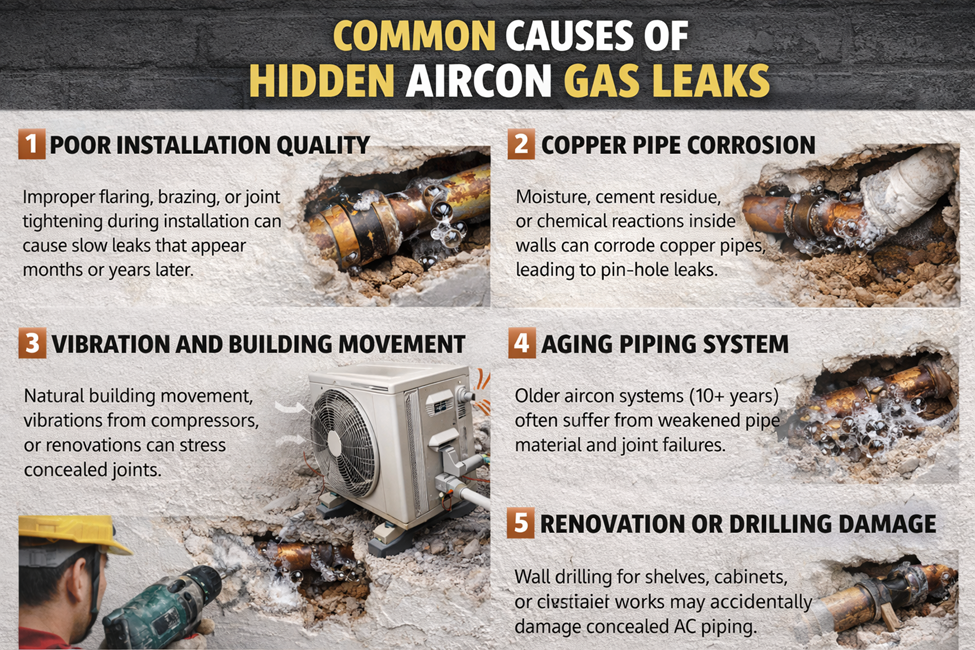
1. Poor Installation Quality
Improper flaring, brazing, or joint tightening during installation can cause slow leaks that appear months or years later.
2. Copper Pipe Corrosion
Moisture, cement residue, or chemical reactions inside walls can corrode copper pipes, leading to pin-hole leaks.
3. Vibration and Building Movement
Natural building movement, vibrations from compressors, or renovations can stress concealed joints.
4. Aging Piping System
Older aircon systems (10+ years) often suffer from weakened pipe material and joint failures.
5. Renovation or Drilling Damage
Wall drilling for shelves, cabinets, or electrical works may accidentally damage concealed AC piping.
Signs You Have a Hidden Aircon Gas Leak

Look out for these warning signs:
❄️ Cooling improves briefly after gas top-up, then drops again
💸 Frequent gas top-ups within months
⚡ Higher electricity bills due to inefficient cooling
🧊 Ice forming on indoor unit piping
🌬️ Weak airflow despite clean filters
🛑 Outdoor unit cutting off frequently
If two or more signs appear together, a concealed leak is very likely.
Why Repeated Gas Top-Ups Are Dangerous
1. Compressor Damage
Low refrigerant levels cause the compressor to overheat. Compressor replacement is one of the most expensive aircon repairs.
2. Increased Energy Consumption
An under-gassed system works harder, consuming more electricity while delivering less cooling.
3. Environmental Impact
Refrigerant gas is harmful to the environment if released continuously.
4. Escalating Repair Costs
Ignoring leaks often leads to:
Major pipe replacement
Ceiling or wall hacking
System downtime

Why Some Technicians Keep Doing Gas Top-Ups
Unfortunately, not all service providers perform proper diagnostics. Gas top-ups:
Are quick and easy
Cost less upfront
Avoid difficult leak detection work
However, this approach benefits the short term only, not the customer.
A professional contractor should always recommend leak detection if gas loss repeats.
How Hidden Leaks Are Properly Detected
1. Pressure Testing (Nitrogen Test)
Nitrogen is pressurized through the piping system to check pressure drop—an accurate way to confirm leaks.
2. Soap Bubble Test
Applied to exposed joints to identify bubbling at leak points.
3. Electronic Leak Detection
Sensitive tools detect refrigerant traces around concealed areas.
4. Sectional Isolation Testing
Piping sections are isolated to pinpoint which part of the system is leaking.
The Correct Long-Term Solutions
Option 1: Repair Accessible Leak Points

If the leak is near exposed joints or indoor/outdoor units, targeted repair may be possible.
Option 2: Pipe Rerouting (No Hacking)
A common and effective solution in Singapore:
Abandon leaking concealed pipes
Install new exposed piping above ceiling or along walls
Minimal disruption and faster completion
Option 3: Concealed Pipe Replacement (With Hacking)
Used when aesthetics require concealed piping:
Wall or ceiling hacking required
Higher cost and longer downtime
Usually done during renovation
After repair or rerouting, the system is:
Vacuumed
Pressure tested
Recharged with the correct refrigerant amount
Why “Just Top-Up” Is Never a Real Fix
If your AC keeps losing gas:
The system is telling you something is wrong
Repeated top-ups waste money
Delayed action increases repair scope
A professional approach always focuses on root-cause rectification, not repeated refilling.
Preventing Future Aircon Gas Leaks
Use licensed and experienced installers
Avoid drilling walls without checking concealed services
Perform annual professional servicing
Address cooling issues early
Avoid cheap, rushed installation work
When Should You Take Action?
You should stop gas top-ups and request proper inspection if:
Gas is topped up more than once in a year
Cooling lasts less than 3–6 months after refill
Your system is older than 7–10 years
Renovation work was recently done near AC piping

Final Thoughts
An air-conditioning system does not consume gas.If your AC gas top-up keeps failing, the problem is almost certainly a hidden refrigerant leak inside walls or ceilings.
Ignoring it leads to:
Higher bills
Poor comfort
Major component failure
Fixing it properly restores:
Stable cooling
Energy efficiency
Long-term reliability
Need Professional Aircon Leak Detection & Rectification?
📞 Call / WhatsApp: +65 8151 8857🌐 Website: www.aotrinitysg.com.com
Alpha & Omega Trinity Pte LtdTrusted specialists in air-conditioning diagnostics, concealed pipe repairs, and long-term solutions—done right the first time.


Comments